





One of the most common problems in powder filling is that some packs come out underweight and others overweight. Underfilling can lead to customer complaints and legal issues. Overfilling, on the other hand, means product given away unnoticed in every pack. Fill weight variation is often not caused by the filling machine alone: the nature of the product, the way the hopper is fed and the steps before filling also determine the result. In this article, we explain the main causes affecting fill weight in auger powder filling and how to address them.
How Does Auger Filling Measure?
In an auger filling machine, the product sits in a hopper. The filling auger below the hopper turns a set number of revolutions and transfers roughly the same volume of powder into the pack with each revolution. In other words, the machine actually measures volume, not weight. If the weight of one litre of product, that is, its bulk density, changes, the same number of revolutions gives a different fill weight. Most fill weight variation stems from this change.
1. Product Level in the Hopper
When the hopper is full, the weight of the product above compresses the powder in the auger zone. As the hopper empties, this pressure decreases and less product flows for the same number of revolutions. If the hopper is topped up manually at intervals, the fill weight follows the same cycle.
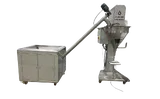
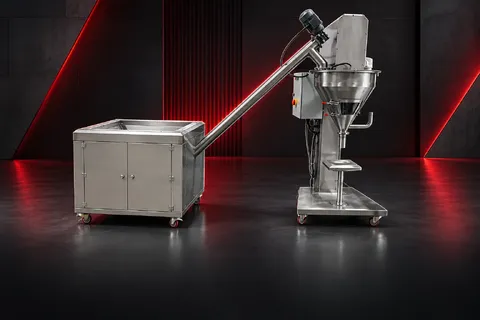
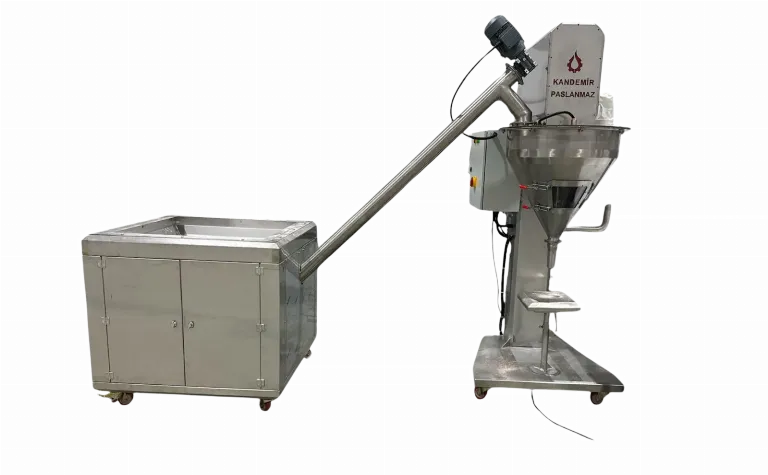
Solution: Keep the hopper at a constant level. A feeding system such as a hopper screw conveyor continuously feeds the filling hopper and prevents the level from fluctuating.
2. Aeration and Settling of the Product
Powder that has just been discharged from the mixer or conveyed contains air and has a low density. Over time, the air escapes and the powder settles. This is one reason for the difference between the first and last packs of the same batch.
Solution: Allow the product to stand under similar conditions before filling, feed the hopper without excessive agitation, and verify the number of revolutions by weighing the first packs at the start of each shift.
3. Poorly Flowing and Lump-Prone Powders
Sticky, hygroscopic or fat-containing powders flow unevenly into the auger zone and can bridge in the hopper. In this case, the auger is not completely filled on some revolutions.
Solution: For such products, filling machines with a hopper feed screw are preferred. The feed screw inside the hopper pushes the product steadily towards the auger. Controlling ambient humidity and not leaving hygroscopic products exposed also reduces lumping.
4. Segregation of the Blend
A homogeneously mixed product can segregate on its way to the filling machine. If fine and coarse particles, or ingredients with different densities, separate from each other, both the weight and the content of each pack change. Conveying, vibration and dropping from height increase this segregation.
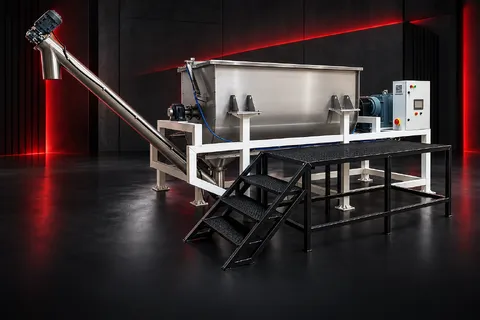
Solution: Plan the transfer from the mixer to the filling machine to be short and with a low drop height. We explain the causes of segregation in detail in our article on powder blend homogeneity.
5. Packaging and Operator
On semi-automatic machines, the operator places the pack under the filling spout. A bag that does not sit properly on the spout, is moved during filling, or has powder spilling around the spout affects the fill weight.
Solution: Use a filling spout suited to the packaging, show operators how to position the pack correctly, and improve repeatability with a sensor-triggered filling mode instead of a foot pedal.
6. Measurement and Monitoring
The first step in correcting fill weight variation is to measure it. Weighing packs at regular intervals and recording the results shows whether the variation is random or follows a pattern. For example, if the variation increases as the hopper empties, the problem lies in the feeding; if it differs at the start of the batch, it lies in the settling of the product.
Choosing the Right Filling Machine
Consistent fill weights start with choosing a machine suited to your product. The flowability of the product, the pack weight, the packaging type and the daily output determine the choice between a semi-automatic and a fully automatic machine. You can explore our Powder Filling Machines and share your product and packaging with us so that we can determine the right model together.