





A homogeneous powder blend means that you find the same composition wherever in the batch you take a sample. This is essential not only for product quality and recipe consistency, but also for ensuring that every pack has the same content at filling. Homogeneity is not determined by the mixer type alone; fill level, mixing time, loading sequence and handling after mixing also directly affect the result. In this article, we look at each of these factors in turn to help you get the best result from your powder mixing machine.
How Is Homogeneity Measured?
Samples are taken from different points in the blend, for example from the top, middle and bottom of the vessel, or from the beginning and end of discharge. The proportion of one recipe ingredient is measured in these samples and the results are compared. The smaller the difference between the results, the more homogeneous the blend. In the feed industry, the coefficient of variation (CV) is commonly used to express this difference.
The ingredient measured is usually one that is present in small amounts in the recipe and is easy to analyse. If the minor ingredient is evenly distributed throughout, the others can be expected to be distributed as well.
1. Fill Level
If the mixer is overfilled, the product has no room to move. If it is underfilled, the mixing action becomes inefficient. Each type has a suitable fill level range:
- Horizontal ribbon: approximately 40–70% of total volume
- V-type and cubic: approximately 40–60%
- Conical: approximately 50–60%
In mixers with a rotating body, the product must be able to fall and change position freely, so exceeding the fill limit is the mistake that degrades blend quality most quickly.
2. Mixing Time
Mixing for longer does not always give a better result. After a certain time, the blend reaches equilibrium. In some blends, as mixing time increases, particles may begin to segregate again, friable granules may be damaged or the product may heat up. In horizontal ribbon mixers, a homogeneous blend is generally achieved in 5–20 minutes. The correct time, however, is specific to each product and is most reliably found by comparing samples taken at different times.
3. Loading Sequence
- Part of the main ingredient is loaded first, so that minor ingredients do not accumulate at the bottom or in the corners of the vessel.
- Ingredients present in very small amounts in the recipe are first made into a premix with a small quantity of the main powder and then added.
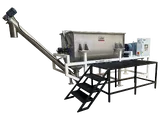
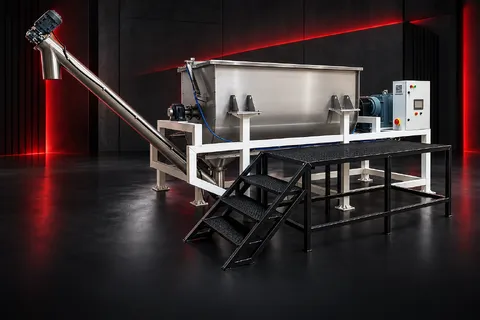
- Liquid additions are sprayed in rather than poured from a single point. In horizontal ribbon mixers, an optional spray system can be used for this.
- The same loading sequence is applied to every batch, so that results are comparable.
4. Segregation
A well-mixed powder can segregate again after leaving the mixer. The main causes of segregation are:
- Particle size difference: With movement and vibration, fine particles sift down between the coarser ones.
- Density difference: Heavier particles gradually settle towards the bottom.
- Heap formation: When product is poured into a heap, coarse particles roll down to the edges of the heap.
Homogeneity therefore needs to be maintained not only in the mixer but also on the way to the filling machine. Reducing drop heights, avoiding unnecessary handling and vibration, and filling the blend without delay wherever possible all reduce segregation.
5. Mixing Granules and Powders Together
When granules and fine powders are in the same recipe, there is both a risk of segregation due to the size difference and a risk of the granules breaking. For friable granules, V-type or cubic mixers with a rotating body provide gentler mixing because they do not apply ribbon pressure. If a horizontal ribbon mixer is used, the ribbon speed must be set to suit the product.
Find the Time and Fill Level on a Small Scale
Finding the correct mixing time for a new product by trial and error on a production machine is expensive. Our laboratory mixers share the same geometry as the industrial models, and their digital speed control and timer make it easy to test different mixing times.
You can browse all models on the Powder Mixers page and send us any questions about your blend.