



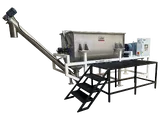
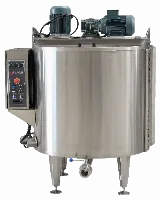
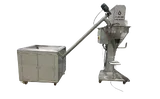
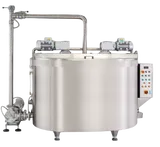


The most common mistake when choosing a powder mixer is to select the machine on its capacity in litres alone. Two mixers of the same volume can give completely different results depending on how the raw material flows: one may produce a homogeneous blend in a few minutes, while the other may segregate the product, break it or leave residue in the vessel. In this guide, we explain step by step how to determine the mixer type, capacity, material and layout, starting from your raw material.
1. Know Your Raw Material First
It is the product itself that determines the mixer type. Knowing the answers to the following questions before requesting a quotation makes the choice much clearer:
- Flow behaviour: Does the product flow freely, or does it tend to stick and form lumps?
- Density and particle differences: Are the densities and particle sizes of the components in the blend similar? The greater the difference, the higher the risk of segregation.
- Friability: Does the granular or crystalline structure need to be preserved?
- Moisture and liquid additions: Will oil, flavouring or another liquid be added to the blend?
- Bulk density: How many kilograms does one litre of the product weigh? The capacity calculation is based on this value.
2. The Four Main Types of Powder Mixer
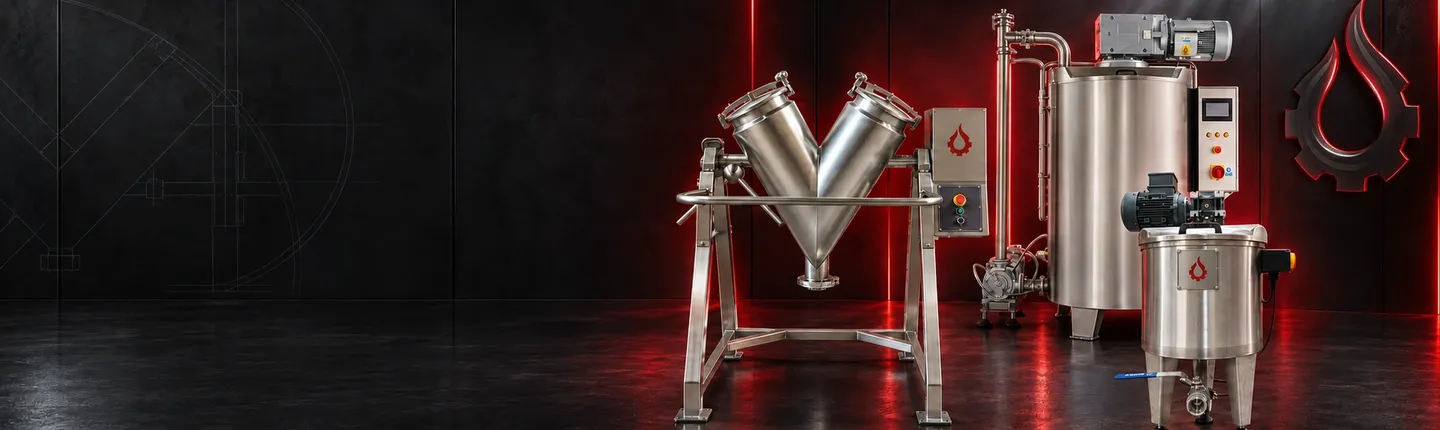
Industrial powder mixers fall into two groups according to their operating principle. In horizontal ribbon mixers, the vessel is stationary and the product is moved by the ribbons inside. In V-type, cubic and conical mixers, the body itself rotates and the product blends by tumbling inside.
| Type | Operating principle | Capacity | Best suited to | Points to consider |
|---|---|---|---|---|
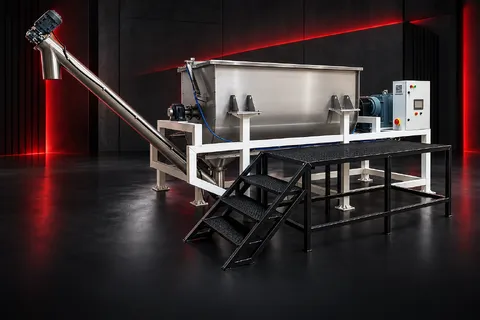
| Horizontal ribbon | Double helical ribbons turning in opposite directions in a stationary U-shaped vessel | 75–10,000 L | Large batches; granular, moist, paste-like blends and those with liquid additions | Ribbon speed must be set correctly for very friable granules |
| V-type | In the rotating V-shaped body, the product splits in two and recombines | 30–2,000 L | Free-flowing powders and granules, recipes with precise ratios | An optional internal agitator may be needed for products that form lumps |
| Cubic | Multi-directional movement in a rotating cube-shaped body | 30–2,000 L | Powders with different densities and particle sizes, frequent recipe changes | A horizontal ribbon mixer is more suitable for very large batches |
| Conical | Rotating vessel tapering into a cone at both ends | 30–2,000 L | Fast discharge with minimal residue, high-value raw materials | A V-type mixer is gentler on very friable granules |
Capacities are the production ranges of our KP series; intermediate volumes are built to project requirements. You can find the operating principle and models of each type in detail on the V-type, cubic and conical mixer pages.
3. Capacity: Machine Volume Is Not Batch Volume
The nominal volume of a mixer is not the amount of product you can mix in one batch. The product needs free space to move within the vessel, and the proportion varies by type:
- Horizontal ribbon: approximately 40–70% of total volume
- V-type and cubic: approximately 40–60%
- Conical: approximately 50–60%
The calculation has two steps. First, divide the batch weight by the bulk density to find the product volume; then divide that volume by the fill level to arrive at the machine volume.
- Example: If a batch contains 400 kg of product with a bulk density of 0.8 kg/L, the product volume is 500 litres.
- If a fill level of approximately 50% is targeted in a cubic mixer, a 1,000-litre model is required.
For your daily production target, also take into account the duration of a single batch: loading, mixing, discharge and, where necessary, cleaning. Sometimes working with two smaller batches on shorter cycles, rather than one large mixer, offers more flexibility, especially in production with frequent recipe changes.
4. Material: Product Contact Surfaces
In our powder mixers, the body and product contact surfaces are made of AISI 304 stainless steel as standard. For corrosive or pharmaceutical-grade raw materials, AISI 316 is used on request. The surface finish also matters: a smooth, polished interior does not retain residue and makes cleaning easier.
5. Cleaning and Recipe Changeover
If you mix several different products in a day, cleaning time is as decisive as mixing time. In such operations, the following features stand out:
- Complete discharge with minimal residue, thanks to a conical outlet or a tilting body
- Wide covers that provide quick access to the vessel
- An interior surface with properly finished welds and corners that does not retain product
6. Layout and Line Integration
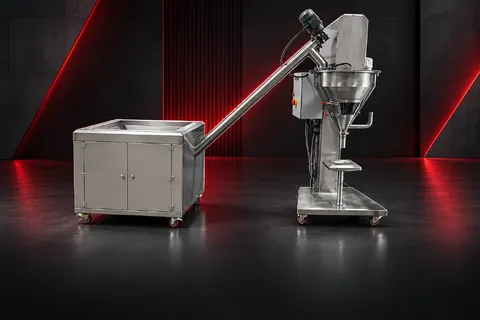
Feeding and discharge heights are as important as the machine's footprint. Product leaving the mixer is usually transferred to a powder filling machine or an intermediate hopper; the height and method of this transfer should be planned at the project stage. For mixers with a rotating body, space should also be allowed around the rotation area for a safety barrier.
7. If in Doubt, Test in the Laboratory
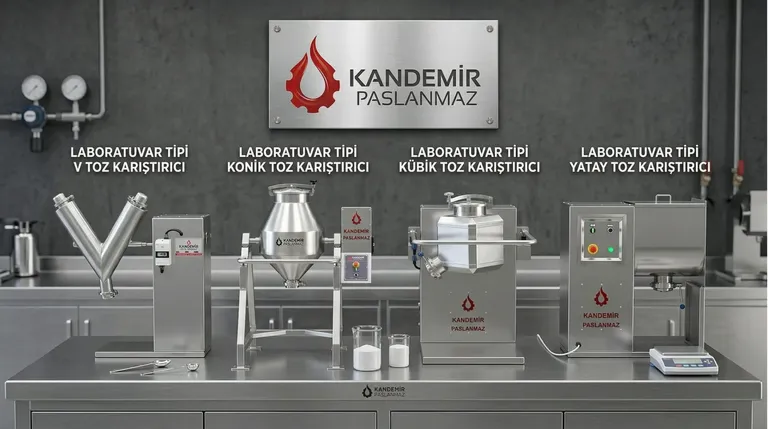
For a new recipe or raw material, it is not always possible to predict in advance which type will give the best result. Our laboratory mixers share the same body geometry as the industrial models and typically work with batches of 1–20 litres. Mixing time and homogeneity results obtained on a small batch can be transferred to a production machine of the same type.
In Summary
- Large volumes, moist blends or blends with liquid additions: horizontal ribbon
- Free-flowing, precisely proportioned and friable products: V-type
- Powders of differing densities and frequent recipe changes: cubic
- High-value raw materials and discharge with minimal residue: conical
You can browse all models on the Powder Mixers page. If you share your raw material, batch size and daily production target with us, we can work out the right type and capacity together.