





How does a conical mixer work?
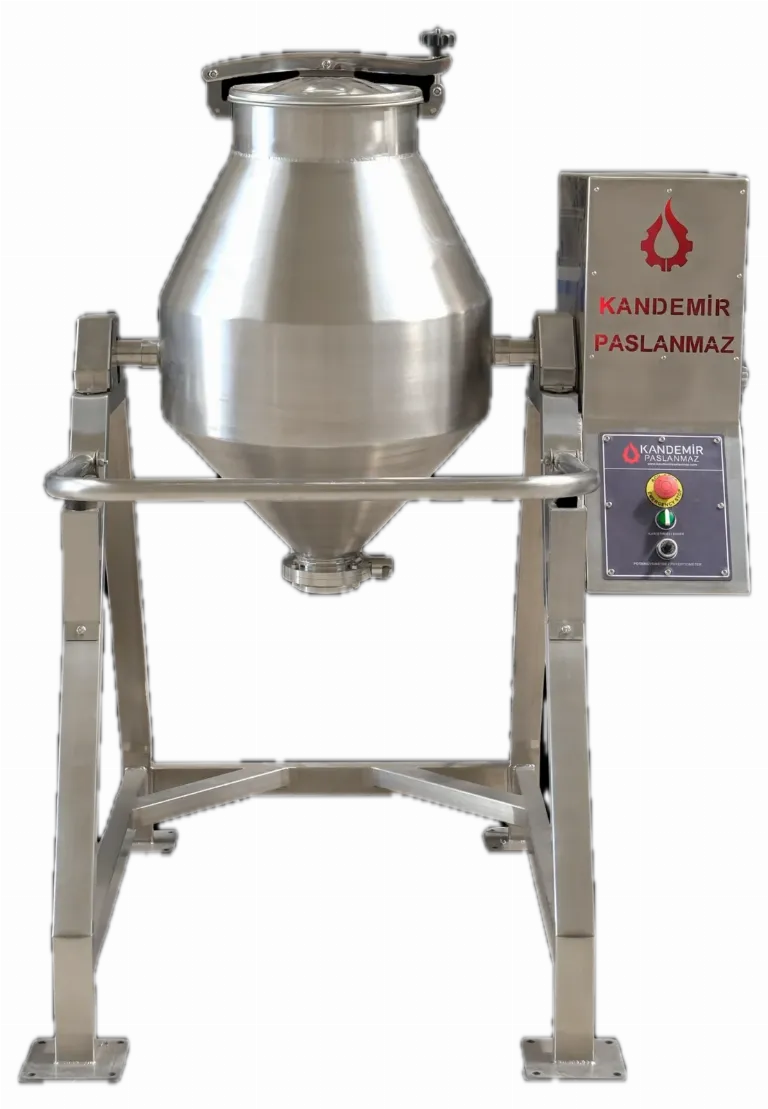
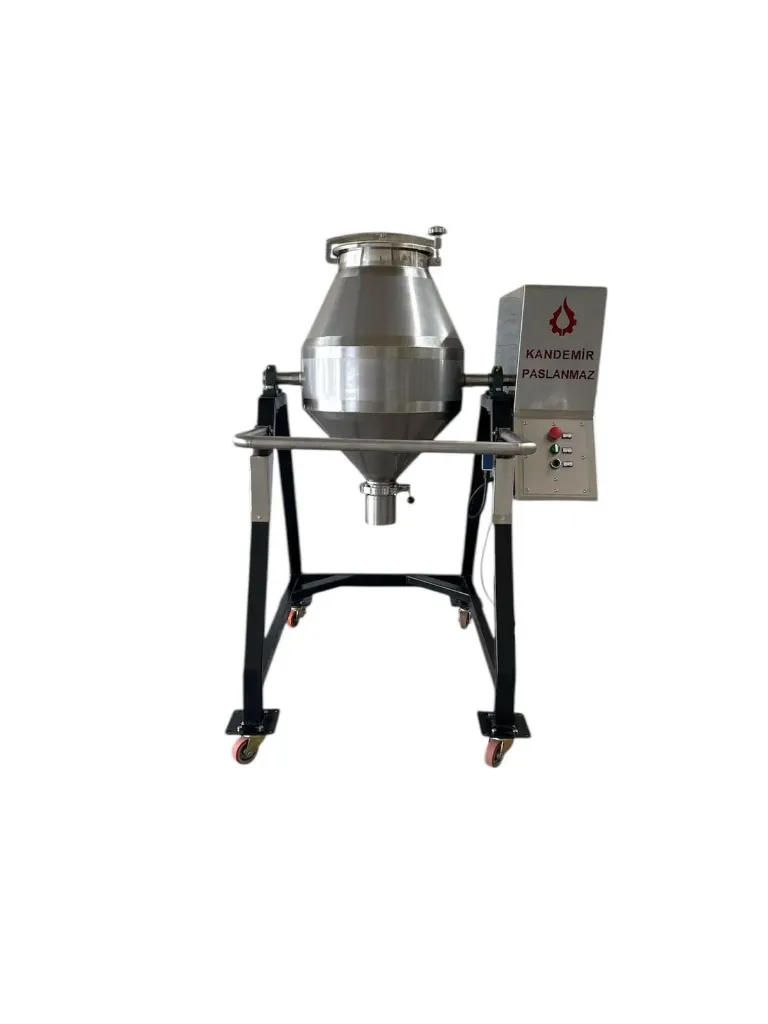
The body of a conical mixer, also known as a double cone blender, is a vessel that tapers into a cone at both ends and rotates around a horizontal axis. As the vessel turns, the product gathers towards the centre along the cone surfaces and spreads out again; this cyclic movement blends powders and granules evenly. The cone-shaped outlet lets the product discharge quickly and with very little residue once mixing is complete.
Capacity and models
We build the KP-KNTK series from 30 to 2,000 litres with motor power from 1 to 15 kW. Our standard models range from 75 to 2,000 litres, and the capacity can be engineered to your requirements. For sample and formulation work, a laboratory conical mixer is also available.
Equipment and options
- Material: Entirely AISI 304 stainless steel including vessel and platform, AISI 316 on request.
- Surface: Polished interior and exterior, or sandblasted exterior, on request.
- Discharge: Residue-free discharge through the conical outlet; practical unloading with an optional trolley.
- Safety: Safety system that stops the machine when the safety barrier is lifted.
How to choose the right capacity
To let the product move along the cone surfaces, a conical mixer is usually filled to 50–60% of its total volume. The bulk density of the product is used to convert batch weight into volume:
- Example: A 250 kg batch of protein powder with a bulk density of 0.5 kg/L has a volume of 500 litres.
- For a fill level of about 50%, a 1,000 litre model is suitable.
When working with valuable raw materials, residue-free discharge matters as much as the right capacity; we also plan the discharge height and the transfer to the filling machine with you at the project stage.
Which products is it suitable for?
Conical mixers stand out in production with valuable raw materials, where product loss and cleaning between batches matter:
- Food: protein powder, sugar, acids, spices, coffee and instant drink powders
- Pharmaceuticals: active ingredients, excipients and granules
- Chemicals and cleaning: powder chemicals, detergent raw materials and paint additives
- Cosmetics: face powders and mineral powders
For very fragile granules a V-type mixer, and for large-volume blends with liquid additives a horizontal ribbon mixer, may be more suitable. You can also read our article on conical powder mixers, where we explain the working principle in detail.
Share your product and batch size with us to request a quote.