



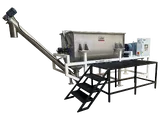
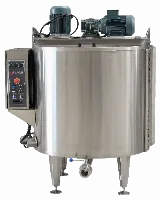
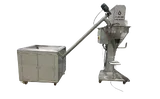
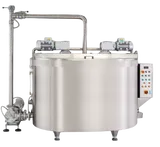


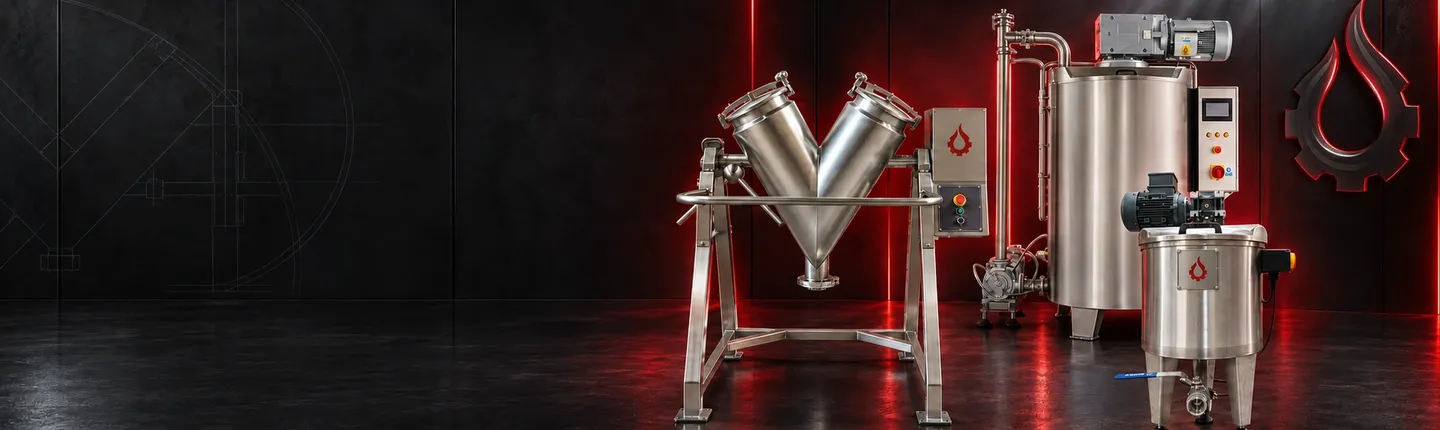
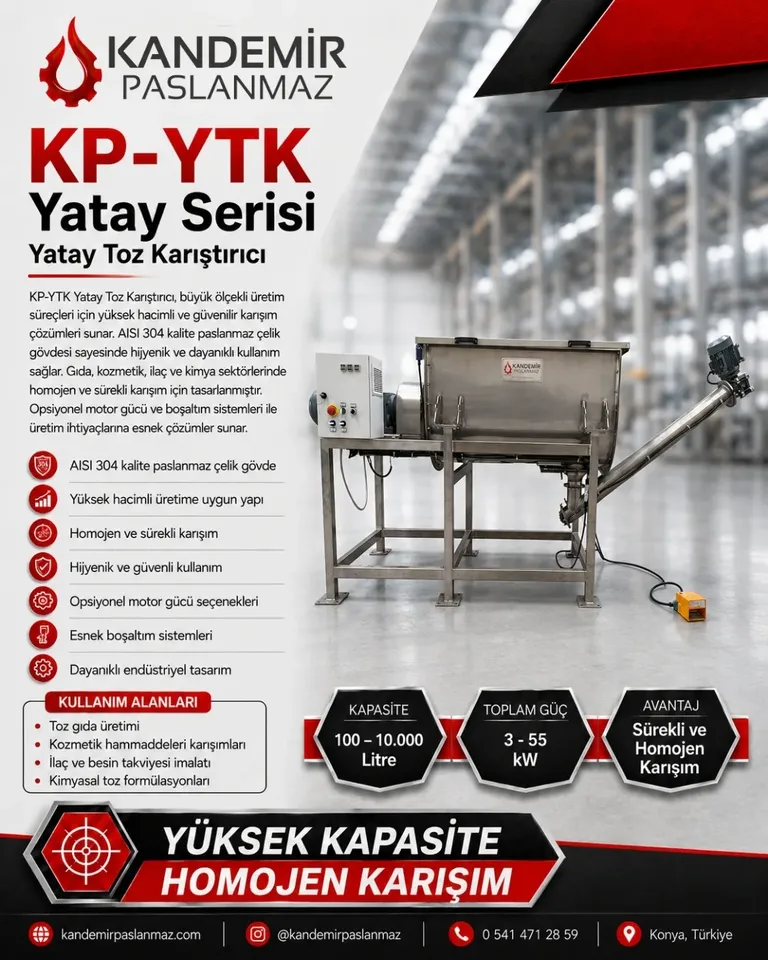
In industrial production, combining different raw materials homogeneously is one of the most critical stages and directly determines the quality of the final product. In industries such as food, chemicals, pharmaceuticals and cosmetics in particular, even micron-sized powders must be blended flawlessly. This is where the KP-YTK Horizontal Series horizontal powder mixer systems, built for high-volume and continuous production, come in.
In this article, we examine the operating principles, advantages and applications of horizontal powder mixer systems, an essential part of modern production facilities, and shed light on how to choose the right mixer for your business.
Operating Principle: How Is a Homogeneous, Continuous Blend Achieved?
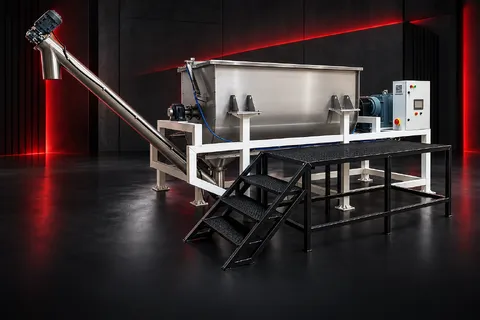
Horizontal powder mixers feature a specially designed double helical ribbon mechanism that rotates axially inside a horizontal U-shaped trough. Known in the industry as a ribbon blender, this bidirectional ribbon design keeps the powder particles moving continuously both from the inside out and from the outside in once the material is loaded into the vessel. Thanks to this three-dimensional flow, even powders with very different densities and particle sizes are blended perfectly in minimal time, without clumping.
Why Kandemir Paslanmaz? All the horizontal powder mixer models we manufacture feature industrial designs focused on maximum sealing, low energy consumption and high operational safety. You can browse our horizontal powder mixer category for our full product portfolio and visit the official Kandemir Paslanmaz website for all our industrial stainless steel solutions.
KP-YTK Horizontal Series Technical Specifications and Capacity Options
The KP-YTK series stainless steel powder mixing machine offers flexibility to suit your production volume and your factory's physical conditions, and is manufactured with a wide range of options. Customization is available from large-scale industrial models to more compact solutions, depending on the size of your facility.
- Body Material: AISI 304 stainless steel body as standard (optional AISI 316 stainless steel mixer depending on the corrosion risk).
- Volume and Capacity Range: A broad industrial production range from 100 liters to 10.000 liters.
- Motor and Drive Power: From 3 kW to 55 kW (optimized according to the specific gravity of the product to be mixed).
- Mixing Characteristics: Highly efficient, homogeneous and continuous mixing with a double helical ribbon system.
- Discharge System: Flexible discharge systems with pneumatic, manual or flap valve options.
- Hygiene Standards: Smooth, easy-to-clean surfaces fully compliant with food and pharmaceutical regulations.
Applications of Horizontal Powder Mixers
Offering hygienic and durable operation thanks to their high-quality stainless steel construction, our KP-YTK series industrial mixer models play a key role across a very wide range of industries:
- Powdered Food Production: Powder food mixing solutions for instant soups, puddings, spice blends, baking powders, coffee-creamer blends, bakery additives and baby food.
- Cosmetic Raw Material Blends: Precise blending of powder blushes, face powders, clay masks and various chemical cosmetic ingredients.
- Pharmaceutical and Dietary Supplement Manufacturing: Precise blends of vitamin powders, sports nutrition products, herbal supplements and pharmaceutical raw materials.
- Chemical Powder Formulations: Construction chemicals, detergents, powder paints, plastic additives and industrial minerals.
Advantages of the KP-YTK Series
- Built for High-Volume Production: A sturdy chassis and powerful bearing systems allow it to mix powder loads weighing several tons effortlessly and without interruption.
- Hygienic and Safe Operation: AISI 304 stainless steel surfaces are smooth, do not harbor bacteria and are fully compatible with cleaning procedures.
- Optional Motor Power and Flexible Discharge: The motor and gear reducer are selected according to the density of the powder to be mixed. At the product outlet, screw conveyor transfer or direct integration with packaging lines can be provided as needed.
- Durable Industrial Design: Equipped with first-class components, from the seals to the electrical panel, to keep maintenance costs to a minimum under heavy-duty operating conditions.
Frequently Asked Questions (FAQ)
Question 1: What is the difference between a horizontal powder mixer and a vertical mixer? Answer: Compared with vertical mixers, a horizontal powder mixer offers a major space advantage in areas with limited ceiling height. The horizontal helical design is also far more efficient at blending powders of differing densities or delicate structure homogeneously, without breaking them, and in much less time.
Question 2: Which grade of stainless steel should be used in mixer manufacturing? Answer: For food, standard chemicals and cosmetics production, an AISI 304 stainless steel body more than meets industry standards. However, when working with highly acidic, abrasive or high-salt chemicals, AISI 316 should be preferred. In our ribbon mixer manufacturing, we tailor this choice to the structure of each customer's raw materials.
Question 3: Is the machine easy to clean and maintain? Answer: Yes, our KP-YTK series machines feature an easy-to-open top lid mechanism and an interior design with no blind spots. This keeps cleaning time between batches to a minimum and prevents lost production time.
Question 4: What should be considered when choosing a capacity? Answer: When choosing a capacity, look not only at the volume in liters but also at the bulk density of the powder to be mixed and the targeted number of daily production cycles. Our expert engineering team calculates the ideal motor power and capacity in liters for you based on an analysis of your raw material. Ribbon blender prices also vary according to the selected capacity and motor power options.
Question 5: Can a heating or cooling jacket be added to the body? Answer: Yes. If the product has to stay at a certain temperature during mixing, a jacket is added to the body and hot water, oil or coolant is circulated through it.
Question 6: Can liquid additives be added to the powder blend? Answer: Yes. Optional liquid spray nozzles add liquid additives to the powder during mixing. Slightly moist products can also be mixed; for very moist or paste-like products the shaft and blades are reinforced.